Unlock the Rare Breed Trigger: Why This Forced Reset Tech Is Changing the Game
A rare breed trigger is a custom firearm component that replaces the standard trigger group to simulate full-automatic fire while technically remaining a semi-automatic action. It works by using the bolt’s recoil energy to reset the trigger and drop the hammer in a rapid, bump-style cycle, letting you rip through rounds as fast as you can hold the trigger down. The payoff is a thrilling, controlled burst of firepower that feels like a machine gun—without the legal headaches of a real one—and it installs in minutes with basic tools for most AR-platform builds. Just drop it in, keep your finger steady, and let the physics do the heavy lifting.
What Makes This Trigger Design Different From Standard AR Triggers
The Rare Breed trigger’s core difference lies in its forced-reset sear, which physically shoves the trigger forward after each shot, mimicking a binary-like cycle without needing a funky selector position. Standard AR triggers rely on your finger to fully release and re-press for every round, creating a natural rhythm cap. The Rare Breed uses a sliding internal cam that catches the hammer, resets the trigger, and fires again the instant your finger relaxes slightly—not fully lifts. This means you can “bump” through a magazine with a straight, steady pull, whereas a standard trigger demands deliberate, separate movements.
The practical result: your trigger finger never breaks contact, turning a light-pull mil-spec or match trigger into a rapid-cycle system that feels like full-auto but is purely mechanical.
That’s the functional gap—standard triggers are binary (pull/release), while the Rare Breed is a continuous-loop reset.
The Internal Geometry That Creates the Shorter Pull
The rare breed trigger’s shorter pull isn’t a trick of springs—it’s carved into the sear geometry itself. A radical angle on the trigger’s engagement surface creates a mechanical advantage that lets the hammer slip earlier, reducing the perceived travel before break. This internal cut shifts the fulcrum point, so the trigger bar’s rotation distance shrinks without sacrificing reset reliability. The result is a crisp, instantaneous release that feels almost pre-travel-free, because the geometry physically removes the standard AR’s slack zone. Every micron of that angled ramp is machined to convert slight finger pressure into immediate hammer fall, not gradual creep.
- The sear’s steep lead-in angle shortens the rotational path to release.
- A relocated pivot point minimizes trigger bar travel before the break.
- The hammer hook’s mating surface is cut to drop earlier under identical force.
Why the Break Feels Cleaner Than Drop-In Cassette Units
The cleaner break of the Rare Breed trigger stems from its sear geometry and hammer angle, which differ from cassette drop-ins. In a cassette unit, the pre-travel and creep are often masked by spring tension, creating a rolling, mushy feel before release. The Rare Breed uses a forced-reset link that resets the hammer with a sharp, mechanical snap, eliminating the spongy pause common in cassettes. This produces a single, crisp wall with no perceptible click before break. For practical shooting, this translates to:
- A shorter trigger take-up that ends abruptly, not gradually.
- A break point that occurs exactly when the sear slips, not after a secondary fn p90 frt internal movement.
- A reset that is tactile and audible, letting you feel the exact moment the sear re-engages without needing to ride a vague bump.
The result is a break that feels like a glass rod snapping, not a lever sliding over a detent—pure mechanical clarity without the dampened feel of cassette internals.
How the Pull Weight and Reset Actually Feel in Live Fire
In live fire, the Rare Breed trigger’s pull weight feels surprisingly heavier than its advertised rating—typically landing around 4.5 to 5 pounds at the shoelace-like take-up, but the break is crisp and short, with zero creep once you hit the wall. The reset, however, is the defining sensation: it’s visceral and tactile, with a pronounced “snap” that travels through the trigger shoe, almost like a mechanical click you can feel in your fingertip before the sear drops again. You don’t ride the reset; you let it slap forward, and the forced-reset mechanism physically shoves the trigger blade forward, which means your finger must consciously lift off and re-engage for each shot—there’s no short-stroke shortcut. That forward push feels aggressive, almost like the trigger is kicking back at you, and it demands a firm, deliberate press to avoid hammer-follow. In rapid fire, the pull weight paradoxically feels lighter because the reset’s momentum helps your finger, but a slow, precision shot exposes the heavier take-up. Dry fire doesn’t replicate the bolt’s recoil impulse that assists the reset, so live fire feels rougher and more mechanical than the bench experience suggests.

Measuring First-Stage Take-Up vs. the Wall
Measuring first-stage take-up versus the wall on a rare breed trigger demands a dial indicator or feeler gauge, not guesswork. The rare breed’s binary-style sear engagement creates a distinctly short, creep-free take-up that transitions into a firm, tactile wall—typically 0.020–0.040 inches of travel before resistance. To isolate the wall definition under live fire, apply slow, incremental pressure while watching the hammer’s rearward movement; the wall is where hammer movement halts despite continued trigger pressure. First-stage take-up is measured from rest to initial sear contact, while the wall is the point of pre-travel termination. A crisp wall reduces unintentional follow-through shots, whereas a mushy wall indicates sear spring over-tension. Use a feeler gauge between trigger and receiver to quantify slack.
- Measure take-up in thousandths of an inch using a dial indicator against the trigger face.
- Distinguish the wall by a sudden rise in resistance without audible click—that’s sear engagement, not reset.
- Test with the hammer cocked and uncocked; rare breed’s wall height changes slightly between modes due to trip lever geometry.

Reset Length and Speed for Fast Follow-Up Shots
The reset on a Rare Breed trigger is incredibly short, making reset length and speed for fast follow-up shots feel almost telepathic. You don’t need to consciously push the trigger forward; just release pressure until you hear a crisp, tactile click. That click arrives after less than a quarter-inch of travel, which is noticeably tighter than a standard mil-spec trigger. This speed means your finger stays in the firing zone, so you can rapidly fire again without breaking your grip or adjusting your hand position. To maximize this, focus on a smooth, deliberate release rather than slapping the trigger. A quick sequence is: 1) Fire the round. 2) Let the trigger reset as you ease pressure. 3) Immediately press again. It becomes rhythm, not thought.
Step-by-Step Installation Tips for a Proper Fit
When you begin, step-by-step installation tips for a proper fit start with clearing the lower receiver and dropping the trigger unit in as one piece, not forcing the hammer forward prematurely. For a Rare Breed trigger, align the rear pins first, then press the front pin through while wiggling the selector—this prevents the sear from binding. Rotate the hammer slowly by hand to confirm it resets with a distinct clack; if it feels spongy, you’ve likely misaligned the disconnect spring, which commonly sits crooked. Tighten the set screws to 12 in-lbs, no more, because over-torquing distorts the housing and changes trigger pull weight. Test with the upper off, pulling the trigger and holding it back while racking the bolt—your Rare Breed should trip each time without a dead trigger.
The moment the slide catches and the hammer stays cocked with your finger still depressed, you know your pin alignment is true.
Finally, add a thin drop of oil to the sear engagement surface, not the springs, and cycle fifteen times dry before reassembling the upper.
Pin Size Checks and Receiver Inlet Compatibility
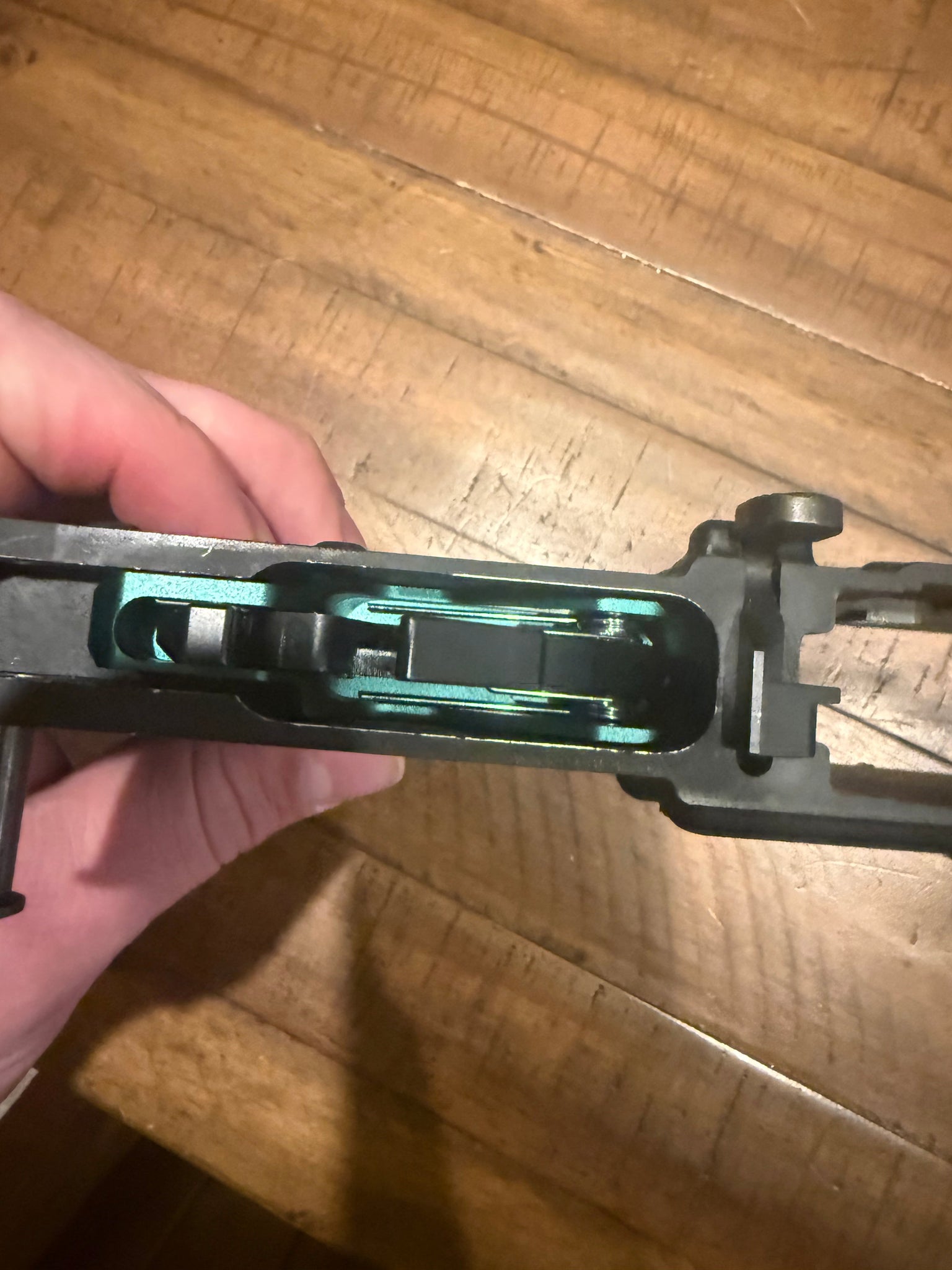
Before you seat your rare breed trigger, always verify the pin diameters against your lower receiver’s holes—most mil-spec triggers use 0.154-inch pins, but some aftermarket housings need 0.170-inch pins, so a quick caliper check saves you from hammering in a pin that’s too thick. Receiver inlet compatibility is just as critical: the trigger cassette or hammer must drop freely into the pocket without binding on the rear walls or the selector detent channel. Even a 0.005-inch burr inside that inlet can make the trigger sit slightly crooked, ruining your sear engagement. Test-fit the trigger *before* installing the grip and safety, then cycle the action by hand to confirm the pins rotate smoothly.
- Measure pin width at both ears—front and rear—because tolerances vary across billet lowers.
- Check the inlet depth with a feeler rarebreed frt gauge; pocket too shallow forces the trigger high, altering reset.
- Deburr sharp edges around the pin holes with fine sandpaper to prevent galling mp5 frt trigger on polymer receivers.
Adjusting Disconnector Engagement Without Tools
For a proper fit, you can fine-tune your rare breed trigger’s disconnector engagement without grabbing a single tool. Start by finger-pressing the disconnector arm forward until it just kisses the hammer’s ledge—no wrench needed. Then, cycle the action slowly by hand; if the hammer slips early, nudge the arm’s bend with a thumbnail, re-testing after each tiny tweak. The goal is a crisp, audible click where the sear holds firm. This **tool-free disconnector adjustment** lets you eliminate trigger slap or misfires straight from the bench. Remember: less is more—overbending can cause dead triggers.
Q: Can I really adjust disconnector engagement without tools on a rare breed trigger?
A: Yep! The rare breed’s design uses a spring-tensioned arm you can gently flex by hand, so a quick push-and-test cycle gets you a solid, safe reset—no screwdrivers involved.

Avoiding Common Overtravel Screw Mistakes During Setup
When setting up your rare breed trigger, the overtravel screw is often where fit goes wrong, as excessive overtravel adjustment creates sear drag. Always back the screw out fully before installation, then thread it in slowly while testing the reset by hand. If the trigger fails to reset crisply, you have advanced too far—turn it back a quarter turn. Avoid using force to seat the screw; it should contact the receiver’s shelf gently, not bind. Also, check that the screw’s set screw is locked with thread locker after final adjustment, since vibration shifts it and causes inconsistency. Measure the overtravel with a caliper between shots to prevent accidental over-insertion.
Practical Use Cases Where This Trigger Shines Best
The rare breed trigger truly shines in fast-paced, low-light home defense scenarios, where the ability to fire multiple aimed shots before an intruder clears a doorway can mean the difference between controlling the hallway and being overwhelmed. In competitive three-gun stages with tight, close-range target arrays, the trigger’s short, crisp reset lets you keep your support hand on the barricade while your trigger finger does the rapid work, shaving seconds off your split times without shifting your stance. For a concealed carrier facing a carjacking while seated, the trigger’s light pull and minimal travel work beautifully because you don’t need to reposition your thumb or adjust your grip—just press and reset, press and reset. Q: Where does it outperform standard triggers? A: In any situation where you must fire repeatedly from a compromised, non-traditional position, like shooting from your back or with one hand pinned. That’s its magic—consistency when your body is not perfectly aligned, turning panic into a rhythmic, controlled response.
Precision Slow Fire at Distance vs. Close-Range Drills
For precision slow fire at distance versus close-range drills, the Rare Breed trigger demands a distinct shift in technique. rare breed mp5 trigger At 50–100 yards, shooters often disable the forced-reset feature to execute single, deliberate shots, as the trigger’s short reset becomes irrelevant; what matters is a crisp, predictable break that won’t disturb sight alignment. Conversely, in close-range drills (under 10 yards), the binary-like function shines during rapid double-taps, allowing two rounds to fire before recoil fully disrupts the sight picture. Slow fire exposes the trigger’s inherent creep, while close-range work masks it—so dry-fire practice should focus on the former’s wall, not the latter’s speed.
Which setting does the Rare Breed trigger perform worse in? It performs worse in precision slow fire, where the exaggerated reset cycle can cause shooter-induced trigger slap, shifting the point of impact off target.
Pairing It With Lightened Hammer Springs for Reliable Ignition
For the Rare Breed trigger to function at its intended cyclic rate, the hammer must return with sufficient force and speed, yet the standard hammer spring often creates excessive trigger pull weight that hinders the system’s timing. Pairing it with lightened hammer springs for reliable ignition reduces the trigger’s reset resistance, allowing the sear to re-engage faster and more consistently under rapid fire. However, the choice must be deliberate: too light a spring risks light primer strikes, so a balanced spring—typically around 4.5 to 5.5 pounds—ensures the hammer’s inertia remains adequate for hard military primers while still slimming the pull weight to a level where the Rare Breed’s forced reset becomes predictable. This combination also mitigates trigger-finger fatigue during extended shooting sessions, since less rearward pressure is needed to cycle the action. The result is a smoother, more reliable ignition cycle that preserves the trigger’s aggressive reset without sacrificing primer strike energy.
Lightened hammer springs lower reset resistance and pull weight, enabling faster Rare Breed cycling, provided the spring weight is tuned to maintain reliable primer ignition.
Key Questions Users Ask Before Buying One
Before grabbing a rare breed trigger, the biggest question is always whether it’ll fit your specific lower receiver—these aren’t drop-in for every AR platform, so you’ll want to check compatibility with your safety selector and hammer geometry. You’ll also ask how the reset feels: is it short and tactile enough for fast shooting, or does it get mushy under heat? Another key one is whether the trigger’s binary or forced-reset mode is actually reliable with your ammo type, especially light loads that might not cycle. And don’t forget the pull weight—are you okay with a heavier first stage to prevent frt-mr3 accidental doubles? Nobody mentions that the “rare” part often means zero aftermarket springs, so you’re stuck with factory tuning. Finally, ask yourself if the warranty covers the sear surfaces wearing out, because these triggers get hammered. Test it dry before buying if you can, and check forums for real owner failures—not just hype.

Will It Work With Binary or Forced Reset Kits?
When considering a rare breed trigger compatibility, the first hard truth is that it is **not** a drop-in with binary or forced reset kits—it operates on a fundamentally different sear geometry and reset cycle. A binary fires once on pull and once on release, while a forced reset uses spring tension to slam the trigger forward; the rare breed’s cam-driven, inertia-based design will physically bind or fail to reset with either module installed. You cannot mix parts: the rare breed’s hammer and disconnector are proprietary, so swapping in a binary’s trip lever or a forced reset’s return spring will cause misfires or dead triggers. Some users attempt a “dual trigger” setup on separate lowers, but that requires two complete fire control groups—not a drop-in swap. The practical answer: buy the rare breed as a standalone, and leave binaries or forced resets in their own dedicated lowers.
How Does It Compare to a Shoe Swap or Trigger Job on a Stock Assembly?
A rare breed trigger fundamentally changes the firing cycle, whereas a shoe swap or trigger job on a stock assembly only alters pull weight, travel, or creep. A shoe swap changes the physical contact surface but rare breed super safety retains the original sear geometry and reset timing. A trigger job—whether polishing, spring replacement, or custom sear engagement—improves tactile feel but still relies on the stock hammer’s reset distance and lock time. In contrast, a rare breed trigger replaces the internal mechanism to enable a forced reset, where the trigger physically pushes forward after each shot. This creates a dramatically different cadence and recoil impulse. With a shoe swap or trigger job, you must manually release and re-press the trigger for every round. The rare breed trigger requires no change in finger position, only sustained pressure, making the shooting experience—and the trigger’s internal wear profile—completely distinct.
Q: How does a rare breed trigger compare to a shoe swap or trigger job on a stock assembly?
A: A shoe swap or trigger job refines a single pull (lighter, crisper) but keeps the stock semi-auto function. A rare breed trigger replaces the sear/hammer interaction to generate a forced-reset cycle, so you hold the trigger down and it fires repeatedly. This is not a modification of the original pull—it is a different operating principle, with faster shot-to-shot times and heavier, more aggressive recoil management.
Signs of Proper Break-In and When to Re-Grease the Seer
A proper break-in reveals itself through a consistent, crisp reset and a trigger pull that feels identical shot after shot, with no creeping or stacking. If your Rare Breed trigger starts exhibiting a gritty texture or a slower reset, that is your cue to re-grease the seer. Do not wait for a malfunction; lubrication is preventative, not reactive. Follow this sequence: first, confirm the hammer drops with zero drag; second, check that the sear engagement feels positive, not mushy; third, after roughly 1,500–2,000 rounds, apply a thin layer of high-quality grease directly to the seer surfaces. Re-greasing the seer every few range sessions, or immediately after any cleaning that strips old lubricant, ensures the trigger’s hyper-fast reset never degrades. If you feel any hesitation in the bow-tie linkage, you have waited too long.